Variegated agave plants, with their striking leaf patterns and architectural forms, are increasingly popular additions to gardens worldwide. This guide delves into the fascinating world of these succulents, covering everything from identification and care to propagation techniques and landscaping applications.
We’ll explore the diverse varieties available, providing insights into their unique characteristics and cultivation needs. Whether you’re a seasoned gardener or a curious beginner, get ready to uncover the beauty and versatility of variegated agaves.
From understanding their botanical classification to mastering propagation methods, we’ll equip you with the knowledge to successfully cultivate and showcase these stunning plants. We’ll also delve into the art of landscape design, showcasing how variegated agaves can transform any outdoor space.
Prepare to be inspired by their unique beauty and discover the secrets to their successful cultivation.
Variegated Agave Plant Identification
Variegated agaves are prized for their striking leaf coloration, adding a unique aesthetic to any landscape. Understanding their visual characteristics and botanical classification is crucial for proper identification and cultivation.
Variegated Agave Visual Characteristics
Variegated agaves display a range of leaf color variations, typically featuring combinations of green, yellow, white, or even bluish hues. These colors often appear in stripes, margins, or as irregular splashes across the leaves. Leaf shapes vary widely depending on the species and cultivar, ranging from the long, pointed leaves of Agave americanato the shorter, more rounded leaves of Agave attenuata.
Leaf texture can also differ, with some exhibiting smooth surfaces while others have a more rugged, spiky appearance.
Comparing Variegated Agave Varieties
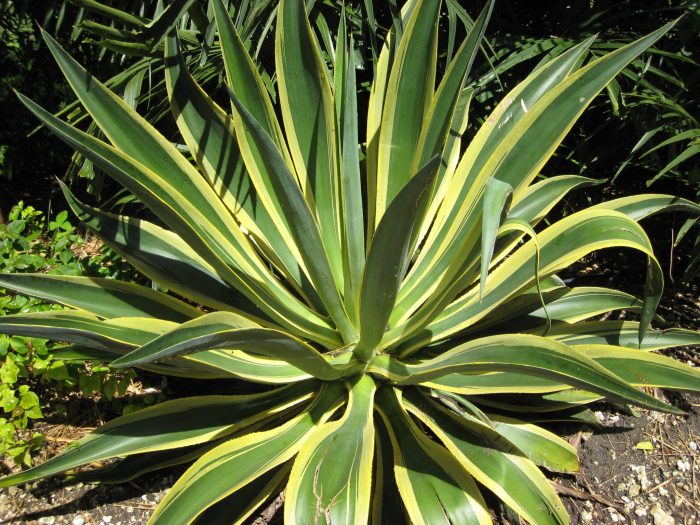
Several variegated agave varieties exist, each possessing unique characteristics. For instance, Agave americana‘Variegata’ is known for its bold yellow margins, while Agave attenuata‘Variegata’ shows subtle yellow variegation along its softer, less spiky leaves. Agave parryi‘Variegata’ often presents with creamy-white or yellow stripes running lengthwise along its leaves.
These variations in color intensity, pattern, and leaf shape allow for diverse landscaping choices.
Variegated Agave Botanical Classification
Variegated agaves belong to the genus Agavewithin the family Asparagaceae. The variegation is a result of a genetic mutation affecting chlorophyll production, leading to the diverse color patterns. Precise taxonomic classification often requires detailed analysis of morphological characteristics and genetic markers, further specifying the cultivar and its lineage.
Visual Guide to Variegated Agave Types
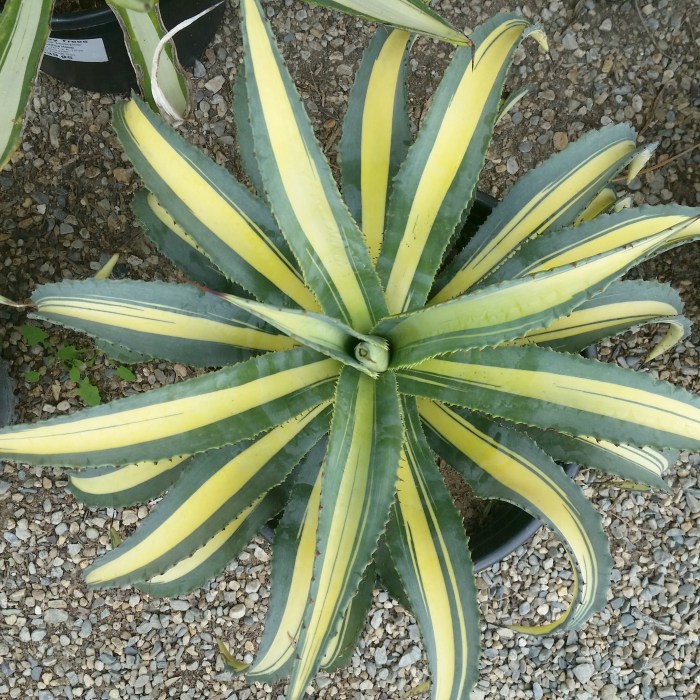
The following table provides a visual representation of different variegated agave types, though the visual aspects must be imagined based on the provided descriptions. Actual appearance will vary based on growing conditions and individual plant characteristics.
| Agave Variety | Leaf Color | Leaf Shape | Notable Features |
|---|---|---|---|
| Agave americana ‘Variegata’ | Green with bold yellow margins | Long, pointed, rigid | Large size, prominent spines |
| Agave attenuata ‘Variegata’ | Green with subtle yellow variegation | Shorter, curved, less spiky | Smooth leaves, foxtail-like appearance |
| Agave parryi ‘Variegata’ | Green with creamy-white or yellow stripes | Broad, somewhat stiff | More compact growth habit |
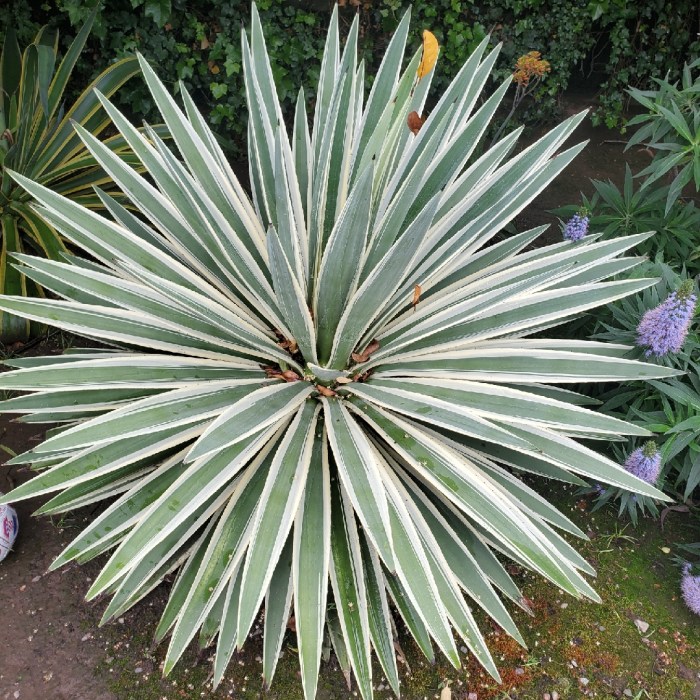
| Agave victoriae-reginae ‘Variegata’ | Dark green with creamy white margins | Short, triangular, sharply pointed | Very compact and geometric growth |
Cultivation and Care of Variegated Agaves
Providing the right conditions ensures the vibrant colors and healthy growth of your variegated agave. Proper watering, fertilization, and pest control are key to their success.
Optimal Growing Conditions for Variegated Agaves
Variegated agaves thrive in full sun to partial shade, depending on the specific variety and climate. Well-draining soil is essential to prevent root rot. They are generally tolerant of a wide range of temperatures, but extreme cold can damage or kill them.
Amend heavy clay soils with sand or perlite to improve drainage.
Watering and Fertilizing Variegated Agaves
Water deeply but infrequently, allowing the soil to dry out completely between waterings. Overwatering is a common cause of root rot. Fertilize sparingly, using a balanced, slow-release fertilizer once or twice a year during the growing season. Avoid excessive nitrogen, which can diminish variegation.
Propagation Methods for Variegated Agaves
Variegated agaves can be propagated through several methods, each with its own advantages and disadvantages. Choosing the right method depends on the specific variety and the grower’s resources.
- Offsets: These are small plants that grow from the base of the mother plant. They can be carefully separated and potted individually.
- Cuttings: Stem cuttings can be taken from healthy stems, allowed to callus, and then planted in well-draining soil.
- Tissue Culture: This laboratory technique allows for mass propagation of genetically identical plants.
Common Pests and Diseases Affecting Variegated Agaves
- Root rot:Caused by overwatering and poor drainage. Prevent by using well-draining soil and watering carefully.
- Mealybugs:These insects suck sap from the plant, causing stunted growth. Treat with insecticidal soap or neem oil.
- Scale insects:Similar to mealybugs, they can be controlled with insecticidal soap or neem oil.
- Fungal diseases:Proper watering and good air circulation can help prevent fungal problems.
Landscape Design with Variegated Agaves
The striking foliage of variegated agaves makes them versatile additions to various landscape designs. Their architectural forms and drought tolerance make them ideal for modern, desert, and xeriscape gardens.
Incorporating Variegated Agaves in Different Garden Styles
In modern gardens, variegated agaves provide strong vertical accents and textural contrast. Their sculptural forms complement clean lines and minimalist designs. In desert gardens, they blend seamlessly with native succulents and cacti. They also thrive in xeriscapes, requiring minimal water once established.
Adding Visual Interest and Texture
Variegated agaves add dramatic visual interest through their contrasting leaf colors and patterns. Their architectural forms create focal points and define spaces. The textures of their leaves, ranging from smooth to spiky, add further dimension to the landscape.
Suitable Companion Plants
Companion plants should complement the agave’s form and color. Consider drought-tolerant succulents, grasses, and other desert plants. The specific choices will depend on the overall garden design and climate.
Creative Uses in Xeriscaping
Variegated agaves are perfect for xeriscaping, requiring minimal water and maintenance. They can be used as specimen plants, grouped together for a dramatic effect, or incorporated into rock gardens or gravel mulched beds. Their low water needs make them environmentally friendly choices for water-wise landscaping.
Variegated Agave Plant Propagation Techniques
Successful propagation requires attention to detail and understanding of each method’s nuances. Here’s a closer look at the most common techniques.
Propagating Variegated Agaves Using Offsets
Offset propagation is the simplest method. It involves separating the small plants that grow from the base of the mother plant. This is generally best done in spring or early summer.
| Step | Materials Needed | Potential Challenges |
|---|---|---|
| Identify healthy offsets | Sharp knife or trowel | Damage to mother plant or offsets |
| Gently separate offsets from mother plant | Potting mix, pots | Rotting if not properly planted and watered |
| Allow offsets to callous | Fungicide (optional) | Infection from improper sanitation |
| Plant offsets in well-draining potting mix | Watering can | Slow growth or failure to establish |
Propagating Variegated Agaves Through Stem Cuttings
Stem cuttings are less common but can be successful with certain agave varieties. This method requires careful handling and proper sanitation to prevent rot.
| Step | Materials Needed | Potential Challenges |
|---|---|---|
| Select a healthy stem section | Sharp, sterile knife or shears | Rotting due to improper sanitation or moisture |
| Cut stem into sections, allowing for callusing | Rooting hormone (optional) | Failure to root due to lack of moisture or fungal infection |
| Plant cuttings in well-draining mix | Potting mix, pots | Slow growth or failure to establish |
| Maintain consistent moisture | Watering can | Infection from improper sanitation |
Tissue Culture Propagation
Tissue culture is a laboratory-based method that allows for rapid and large-scale propagation of genetically identical plants. While highly efficient, it requires specialized equipment and expertise.
- Advantages:High propagation rates, disease-free plants, preservation of rare varieties.
- Disadvantages:High initial cost, requires specialized equipment and knowledge.
Comparing Propagation Methods
Offset propagation is the easiest and most widely used method for home growers. Stem cuttings are less reliable but can be attempted. Tissue culture offers the highest efficiency but is not practical for most home gardeners.
Illustrative Descriptions of Variegated Agave Varieties: Variegated Agave Plant
Here are detailed descriptions of three common variegated agave varieties. Remember that individual plant appearances can vary.
Agave americana ‘Variegata’
This iconic agave boasts large, robust rosettes of leaves, typically reaching several feet in diameter. The leaves are long, pointed, and rigid, with prominent marginal spines. The defining characteristic is the bold, bright yellow margin that contrasts sharply with the central green of the leaf.
The leaf texture is relatively smooth, but the spines are sharp and can cause injury.
Agave attenuata ‘Variegata’, Variegated agave plant
Unlike the spiky A. americana, Agave attenuata‘Variegata’ features softer, less spiky leaves. The leaves are shorter, more curved, and generally lack the prominent terminal spine. The variegation is often more subtle, with a gentle yellow or creamy-white streaking or marbling along the leaves.
The overall appearance is smoother and more rounded, giving it a gentler, foxtail-like form.
Agave parryi ‘Variegata’
Agave parryi‘Variegata’ tends to have a more compact growth habit compared to the previous two. The leaves are broader and somewhat stiff, with a distinct, somewhat bluish-green coloration. The variegation typically presents as creamy-white or pale yellow stripes running lengthwise along the leaves.
The leaves are often slightly recurved, and the spines, while present, are less pronounced than in A. americana.
Ending Remarks
Variegated agave plants offer a unique blend of beauty, resilience, and versatility, making them ideal additions to diverse garden settings. By understanding their specific needs and utilizing appropriate propagation techniques, you can successfully cultivate these striking succulents and enjoy their captivating presence for years to come.
Their bold patterns and architectural forms add a touch of modern elegance, while their drought tolerance makes them perfect for sustainable landscaping. Embrace the beauty and resilience of variegated agaves and let their captivating presence enhance your outdoor space.
FAQ
Are variegated agaves difficult to care for?
Once established, variegated agaves are relatively low-maintenance. They thrive on neglect and require minimal watering, making them ideal for busy gardeners.
How much sunlight do variegated agaves need?
Most variegated agaves prefer at least 6 hours of direct sunlight daily. However, some varieties tolerate partial shade, especially in hotter climates.
Can I grow variegated agaves in containers?
Yes, many variegated agave varieties grow well in large containers, making them suitable for patios, decks, and balconies.
What is the best time to propagate variegated agaves?
Spring and early summer are generally the best times to propagate, as the warmer temperatures promote faster root development.