Types of agave plants offer a fascinating glimpse into the diverse world of succulents. From the small, spiky specimens perfect for rock gardens to the majestic, tree-like varieties dominating landscapes, agaves boast incredible variety. Their history is rich, interwoven with the cultures of Mexico and beyond, where they’ve served as sources of food, fiber, and even potent spirits for centuries.
This exploration delves into the remarkable adaptations, diverse uses, and captivating beauty of these remarkable plants.
We’ll journey through the different ways to categorize agaves, examining their size, growth habits, and striking leaf characteristics. We’ll map their geographical distribution, highlighting the environmental factors that shape their evolution. Finally, we’ll uncover their crucial roles in culinary traditions, sustainable practices, and the art of landscaping.
Agave Plants: A Comprehensive Overview
Agave, a genus boasting over 200 species, is a captivating group of succulent plants native to the Americas. These remarkable plants have played a crucial role in the history and culture of numerous societies, providing sustenance, materials, and even spiritual significance.
Their unique adaptations to arid and semi-arid environments are truly fascinating, showcasing nature’s ingenuity.
Agave Plant Adaptations and Survival Mechanisms
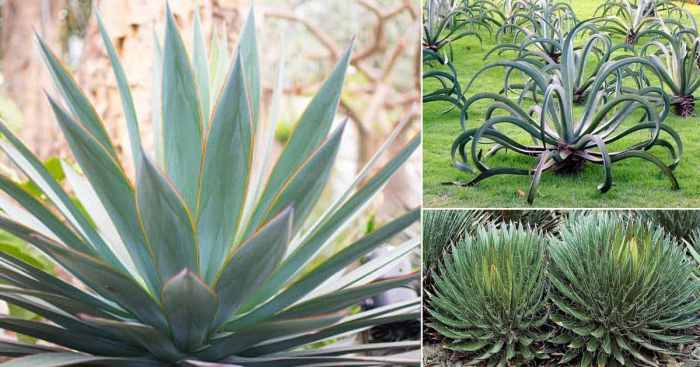
Agave plants are masters of survival in harsh conditions. Their thick, fleshy leaves store water efficiently, allowing them to endure prolonged droughts. Many species possess spiny leaves, deterring herbivores and reducing water loss. Their extensive root systems quickly absorb any available moisture after rainfall.
Some species even exhibit crassulacean acid metabolism (CAM), a photosynthetic pathway that minimizes water loss during transpiration.
Categorizing Agave Plants by Size and Growth Habit
Agave plants exhibit a remarkable diversity in size and growth habit. Categorizing them based on these characteristics provides a clearer understanding of their variations.
| Size | Growth Habit | Examples | Typical Growth Rate |
|---|---|---|---|
| Small | Rosette | Agave stricta, Agave parryi | Slow to moderate; several years to reach maturity |
| Medium | Rosette | Agave americana, Agave shawii | Moderate; several years to reach maturity |
| Large | Rosette | Agave attenuata, Agave victoriae-reginae | Slow; many years to reach maturity |
| Medium | Tree-like | Agave sisalana | Moderate; several years to reach maturity |
Agave Plant Classification Based on Leaf Characteristics
Leaf characteristics are crucial for identifying different agave species. Variations in shape, texture, and color provide valuable distinguishing features.
- Leaf Shape:Leaves can be lanceolate (lance-shaped), ovate (egg-shaped), or even cylindrical, depending on the species.
- Leaf Texture:Some agave leaves are smooth, while others are rough or fibrous.
- Leaf Color:Agave leaves exhibit a wide range of colors, from various shades of green and blue-green to gray, and even variegated forms with stripes or markings.
Leaf Margin Types:
- Smooth
- Serrated
- Spiny
Agave Species and Their Geographic Distribution, Types of agave plants
Agave species are distributed across a wide range of habitats in the Americas. Their distribution is significantly influenced by factors such as rainfall, temperature, and soil type.
A descriptive map of agave distribution would show a concentration of species in Mexico, particularly in arid and semi-arid regions. Species like Agave tequilana(blue agave) are found in specific regions of Mexico, while others, such as Agave americana(century plant), have a broader distribution across the southwestern United States and Mexico.
Further south, various agave species are found in Central and South America, adapting to different ecological niches.
Agave Plants Used for Food and Beverages
Agave plants have long been a valuable source of food and beverages. The sap, or aguamiel, is harvested from the heart of mature agave plants. This sap is then fermented to produce pulque, a traditional alcoholic beverage. Certain agave species, notably Agave tequilana, are used to produce tequila, while others are used for mezcal.
The nectar from various agave species can be processed into syrups and sweeteners, with different species offering unique flavor profiles and chemical compositions. The processing methods and resulting products vary significantly across different species and regions.
Agave Plants Used for Fiber and Other Products
Agave fibers have been utilized for centuries in textiles and various crafts. The fibers are extracted from the leaves, often through a process involving mechanical separation and cleaning. These fibers are strong, durable, and relatively easy to work with.
Traditionally, agave fibers were used to make rope, mats, and clothing. Today, they find applications in a range of products, including fabrics, upholstery, and even bioplastics, promoting sustainable practices.
Agave Plants in Landscaping and Horticulture
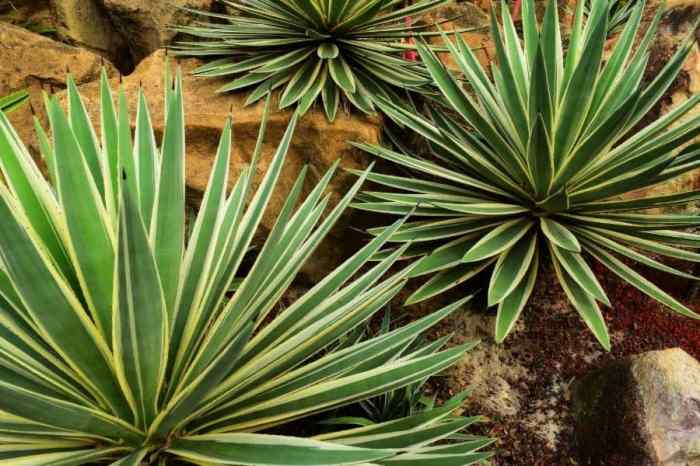
Agave plants are increasingly popular in landscaping due to their architectural forms, striking foliage, and relatively low maintenance requirements. Their drought tolerance makes them well-suited for xeriscaping and water-wise gardens. Successful cultivation requires well-draining soil and ample sunlight. Different species have varying tolerance to frost and cold temperatures.
Proper planting and minimal care ensures the agave thrives and enhances the aesthetic appeal of any landscape.
Conservation Status and Threats to Agave Plants
Many agave species face threats to their survival, including habitat loss due to urbanization and agriculture, unsustainable harvesting practices, and climate change. Conservation efforts focus on protecting agave habitats, promoting sustainable harvesting techniques, and raising awareness about the importance of preserving agave biodiversity.
Sustainable harvesting, which involves carefully managing agave populations and ensuring that only mature plants are harvested, plays a crucial role in safeguarding agave populations for future generations.
Closing Summary
The world of agave plants is far richer and more complex than initially meets the eye. From the delicate details of their leaves to their significant cultural and ecological impact, agaves demonstrate nature’s remarkable ingenuity. Understanding the different types of agave plants not only enhances our appreciation for their beauty but also fosters a deeper understanding of their vital role in various ecosystems and human societies.
Whether you’re a seasoned botanist or a curious newcomer, the journey into the heart of agave diversity is sure to be rewarding.
Q&A: Types Of Agave Plants
What is the lifespan of an agave plant?
It varies greatly depending on the species, ranging from a few years to several decades. Some only flower once and then die, while others are longer-lived.
Are all agave plants poisonous?
Many agave species have sharp spines that can cause injury, but the plants themselves aren’t inherently poisonous, though some parts may be toxic if ingested.
How do I propagate agave plants?
Agave plants can be propagated from offsets (pups) that grow at the base of the mother plant. These can be carefully separated and planted individually.
Can I grow agave plants indoors?
Some smaller agave species can thrive indoors with sufficient sunlight and well-draining soil. However, most prefer outdoor cultivation.